We Need a New Map
The Old Maps are Dead. We’re Standing in a Different Forest.
 By Marte Martin By Marte Martin
|
April 2026 |
| SUMMARY |
For thousands of years, value was created through subsistence. People produced what they needed to survive, and little more. That was the human story until the control of land and labor changed it. Then trade and merchants grew; empires rose on coins. Then came the 1700s. Steam, steel, oil, and cars. Then electricity and mass production. Wealth exploded through mass production. Then information and networks. Every time the source of value changed, the world followed. Work, cities, and power all adjusted. It felt chaotic at the time; it seems inevitable today. The era of 'Golden Ages' is over. We're now in a new world where bold ideas and fast action matter more than anything else. PART 1: The era of 'Golden Ages' is over.
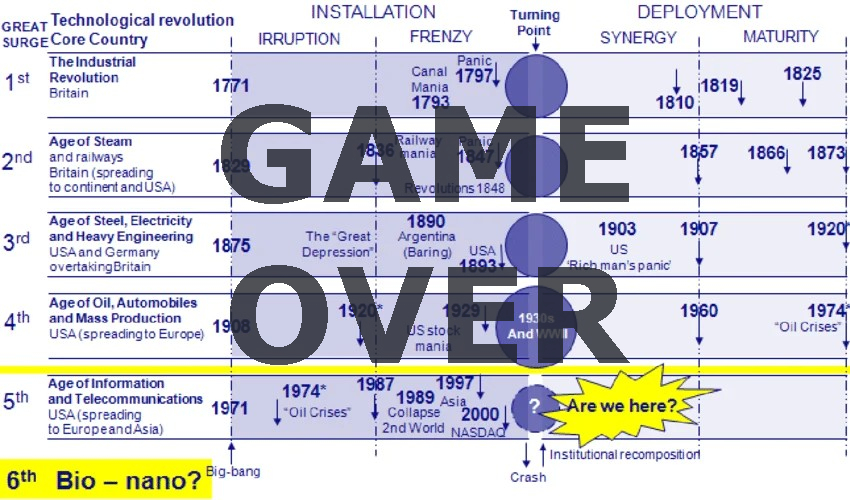
But here's the thing: that pattern of change has broken. These changes were major, and they followed a recognizable pattern that lasted roughly 250 years – until recently. We have exited the great era of sequential technological change. For decades, we’ve used maps like scholar Carlota Perez’s 50-year waves to explain progress, but those maps no longer fit. We are living through a rare, once-in-two-centuries transition, and surprisingly most people haven’t even noticed.
This is a massive shift that only happens once every few hundred years. To give you an idea of how big this is: it’s like the Industrial Revolution, the Chinese Cultural Revolution, and the Renaissance all hitting at once. It is hard to even imagine how much this will change things. The foundations of the old world are gone. The sequence is dead. PART 2: The Break
It is not that you missed the forest for the trees. It is that you suddenly find yourself standing in a different forest. And one where venture and applied creativity at scale are what create movement and progress. The old map worked when change was slow and breakthroughs needed decades to spread.
Take a close look and you will see how much has changed. This shift started in the 2010s when venture thinking became the default logic of the world. Innovation is the new base foundation, and venture is the ruler – it’s now the main driver to create value. Today, intelligence spreads instantly through software and cloud. In this new forest, venture and applied creativity at scale are what create movement and progress. If you are still following the old maps, you are irrelevant. PART 3: The New World
Most people will be pushed around because they don't understand the environment has changed. They see the trees, but the forest is different. And it's not just different, it's completely different. Venture thinking isn't a "sector" anymore; it’s the default logic of the world. Value is captured by those with the bravery to apply vision at high velocity. Adapt to the new forest or get cleared away. It is not a world for the indecisive, but this economy is the ultimate opportunity to live a creative life. Isn't it amazing what’s happening?! PART 4: What Is Actually Happening
- The 250-year Cycle is Over: The rhythmic, 50-year waves of progress we’ve relied on since the 1700s have shattered. Stop waiting for the next "surge"; the sequence is broken.
- The 2010s was the Real Shift: AI isn’t the start of a new era. The environment changed a decade ago when venture went mainstream and "venture thinking" became the only way to survive or excel.
- Test and Learn is Slop: Incrementalism is for people who want to fail slowly. Today, value is captured by those with the bravery to apply vision at great speed. It's no world for the indecisive.
- A New Foundation: We aren't just using new tools; we are operating under entirely new rules of nature and industry. If you’re still following the old maps, you aren't just lost – you’re irrelevant.
- About bold ideas and fast action: The Golden Ages Are Over. The old rules of progress have broken. We're now in a new world where bold ideas and fast action matter more than anything else.
Get Marte's stories in your inbox!Sign up to email list and receive our articles, interviews, feature, and much more.
The Old World
For thousands of years, value was created through subsistence. People produced what they needed to survive, and little more. That was the human story until the control of land and labor changed it. Then trade and merchants grew; empires rose on coins. Then came the 1700s. Steam, steel, oil, and cars. Then electricity and mass production. Wealth exploded through mass production. Then information and networks. Every time the source of value changed, the world followed. Work, cities, and power all adjusted. It felt chaotic at the time; it seems inevitable today. The Golden Ages Are OverThe old rules of progress have broken. We're now in a new world where bold ideas and fast action matter more than anything else.
For thousands of years, the story was simple: people produced to survive. They grew or hunted just enough food to survive, made their own clothes, and built their own shelter. That was it – they produced what they needed, and little more.
Then the story slowly began to change. For many centuries, controlling land and labor (the people who worked the fields) became the main way to gain wealth and power (source of value). If you owned the dirt and the people breaking their backs on it, you owned the world. Later, trade and merchants grew stronger, and empires rose on coins and commerce.
But the real explosion happened in the 1700s. Steam, steel, oil, and cars arrived. We learned to produce more and do it faster. Machines and factories changed everything. Suddenly it was possible to produce far more than before. Wealth exploded through mass production. Nations that mastered machines pulled ahead; everyone else was left in the dust.
By the 1960s, we shifted into services. By the 70s, it was computers and networks. Software and data became the driver. Creative economy ideas grew in the 2000s–2010s, and while creativity became a main asset, it was still just digital knowledge trapped in the same old industrial frameworks. It was 'comfortable'. It was predictable. And it's over.
Every time the main way of creating wealth changed, the world changed with it. Work, cities, power, and daily life all adjusted. The change always felt chaotic while it was happening. Only later did it look inevitable.
The Break
But here's the thing: that pattern of change has broken. These changes were major, and they followed a recognizable pattern that lasted roughly 250 years – until recently. We have exited the great era of sequential technological change. For decades, we’ve used maps like scholar Carlota Perez’s 50-year waves to explain progress, but those maps no longer fit. We are living through a rare, once-in-two-centuries transition, and surprisingly most people haven’t even noticed.
This is a massive shift that only happens once every few hundred years. To give you an idea of how big this is: it’s like the Industrial Revolution, the Chinese Cultural Revolution, and the Renaissance all hitting at once. It is hard to even imagine how much this will change things. The foundations of the old world are gone. The sequence is dead.
That framework was super useful for a long time; it gave us a way to time our greed and society a way to feel in control. But I’m not here to sell you another framework. I’m here to tell you that this specific world of order and 50-year "creative destruction" cycles is gone. You’re sitting around debating whether AI is a "Technological Revolution" or a "paradigm shift" or just "Digital 2.0." Who cares? The question itself is too small now. While the academics and LinkedIn jesters argue over definitions and classifications, the ground has already moved. The maps from 2002, 2009, 2015 or even more recent don’t show the world of 2026.
The underlying shift – venture going mainstream and the massive concentration of talent – has been running for a decade. If you’re asking "what's next," you’ve already missed the fact that "next" started in the 2010s. We aren't in a new wave; we are in a new ocean.
Get Marte's stories in your inbox!Sign up to email list and receive our articles, interviews, features, and much more.
The New World
It is not that you missed the forest for the trees. It is that you suddenly find yourself standing in a different forest. And one where venture and applied creativity at scale are what create movement and progress. The old map worked when change was slow and breakthroughs needed decades to spread. Take a close look and you will see how much has changed.
Take a close look and you will see how much has changed. This shift started in the 2010s when venture thinking became the default logic of the world. Innovation is the new base foundation, and venture is the ruler – it’s now the main driver to create value. Today, intelligence spreads instantly through software and cloud. In this new forest, venture and applied creativity at scale are what create movement and progress. If you are still following the old maps, you are irrelevant. PART 3: The New World
Look at what happens when you talk to AI right now: you can ask it to do deep analysis across history, economics, patterns, and frameworks – and it delivers instantly, for free, in a back-and-forth conversation. That is the new factor. If electricity’s slow rollout counted as revolutionary, this instant rollout counts more.
The old map of technology waves worked when change was slower. On top, the old map draws clean lines where reality is messy. Steam was already in factories by the 1760s. Railways began in the 1820s with iron rails. Steel made them bigger – the two were never truly separate. They evolved together.
Breakthroughs needed decades to spread. Infrastructure had to be built. Institutions had to adapt. Common sense about work and value shifted slowly.
Today the speed is different. Intelligence spreads instantly through software and cloud. It is already cheap and applies to almost everything.
The same is true now. Digital foundations are still there. AI builds on them. But the speed and the nature of what is happening make the old divisions less useful.
What Is Actually Happening
Most people will be pushed around because they don't understand the environment has changed. They see the trees, but the forest is different. And it's not just different, it's completely different. Venture thinking isn't a "sector" anymore; it’s the default logic of the world. Value is captured by those with the bravery to apply vision at high velocity. Adapt to the new forest or get cleared away. It is not a world for the indecisive, but this economy is the ultimate opportunity to live a creative life. Isn't it amazing what’s happening?!
In this new forest, the ability to build things fast is now the primary source of value. The old "sequential" nature of progress is dead. "Test and learn" is dead, it’s just slop now – a way to fail slowly.
This transition started in the 2010s when venture went mainstream and "venture thinking" became the default. The "test and learn" era is over – today, it's mostly considered slop. Success now depends on identifying a fundamental innovation and applying your vision at high velocity. You 'succeed' or 'fail', enjoy the ride, and move on.
Arguably, a fulfilling life is a creative one – whether expressed through science, the arts, or the spiritual. This economy is simply the newest, most aggressive arena to put that creative nature to the test. This is a direct invitation to test your creative nature.

It’s a basic rule: fear is the opposite of the creative spirit. You aren't truly living until you are creating or building something. In the old maps, you managed fear by playing it safe. In this forest, that is how you become irrelevant.
Scale is how the most value will be captured. If you want to contribute, the more creatively you apply yourself, the more you will move the needle. It is a world for courageous.
And AI is not the origin of this new era; it is the evidence that the origin already happened. We are in a reality where the nature of value has fundamentally changed. This period will likely last the rest of the century. Or less – because this change moves faster than anything before it. You either adapt to the new forest, or you get cleared away by it.
The bad news is that there is no map to follow, which many will find scary. The good news is that there is no map to follow, which offers opportunity for fulfillment through creativity – for those with the courage to go after it.
Impact is bigger than prior eras: creativity + vision (you can share with others, right?!) + tech + guts = decides winners.
Effects:
- Jobs: routine work vanishes (not practically, but value wise). Value from creativity + intent + human/AI combos.
- Economy: output surges with less traditional input. Abundance possible. Venture thinking spreads.
- Society: innovation becomes normal. Learning/science/health accelerate. But risks rise too.
- World: talent/venture/networks ecosystems win.
Don't waste time debating labels (like, is AI a tech revolution or did we enter a golden era – because, who cares). Act in the new cycle: maximize your talent stack, embrace risk exploring your limits, move faster. The Innovation Economy is here. Focus on it.
And if fear is the opposite of the creative spirit, and if one cannot truly live until one is creative, then; What's the nature of fear? Why do people have it and why some seem to not have it?
Start where you are:
- Protect time for creative work.
- Try new things. Explore and push your limits.
- Use the tools to amplify your vision, not as a shortcut for thinking.
- Move at high velocity. Identify the innovation and go. When you feel you’re in a place that adds nothing to anyone, just leave. Do it consistently. It is better to be home resting for the next day than wasting your time on zero-value filler.
- Learn to explain systems and potential. If you can't communicate it, it doesn't exist.
We are not going after change, and certainly, we are not waiting for the change. The change is coming towards us and it has already arrived.
Whether a new golden age was coming or not is no longer relevant. We have moved beyond that.
The change is not coming. It is here.
See it for what it is.
This article We Need a New Map appeared first on HDMarte.
Marte Martin is venture associate specializing in entrepreneurial finance, writing about modern enterprise and venture economics.